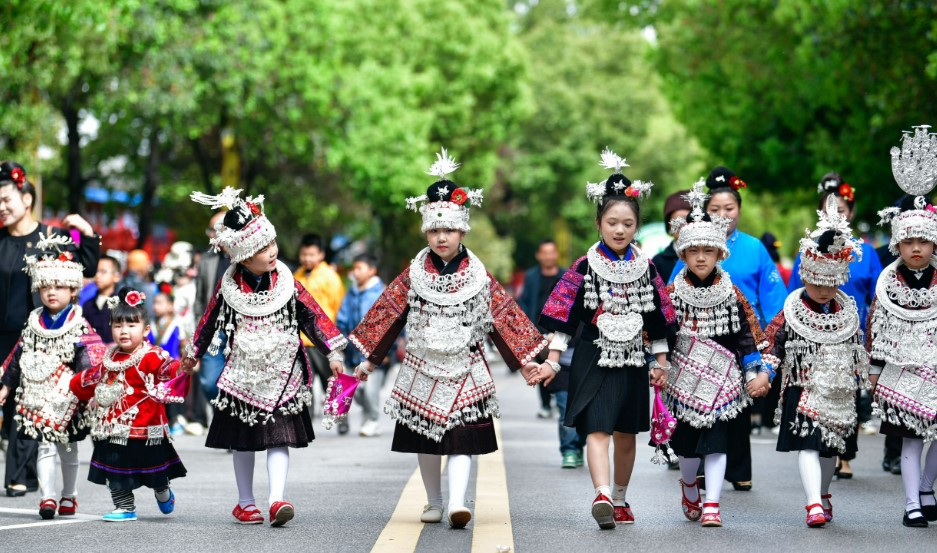
On April 17, the third day of the third lunar month, Taijiang County in Qiandongnan Miao and Dong Autonomous Prefecture, Guizhou Province, welcomed its annual Miao Sisters’ Festival. Revered as “the oldest Valentine’s Day in the East,” this folk celebration kicked off with great fanfare along the banks of the Qingshui River, drawing tens of thousands of locals and tourists from home and abroad to partake in a romantic tradition spanning millennia.
As dawn broke and the morning mist still lingered, Miao girls in Laotun Township began donning their festive attire in front of their stilted houses. The crisp clinking of silver ornaments mingled with birdsong, while the vibrant, embroidered pleated skirts shimmered like rosy clouds in the morning light. Carrying bamboo baskets filled with colorful Sisters’ Rice—a precious token of the festival dyed with plant extracts—each grain concealed the tender feelings of the young women who prepared it.
“The five colors require five wildflowers: purple from sweetflag grass, yellow from yellow rice flowers, black from maple leaves…” explained 65-year-old heritage inheritor Tai Xiuhua, demonstrating the ancient technique to a crowd of young onlookers. She noted that the festival originated from the legend of “Yang Asha” recorded in Miao ancient songs, and the custom of expressing affection through rice and selecting partners through song has been passed down for thousands of years on this land.
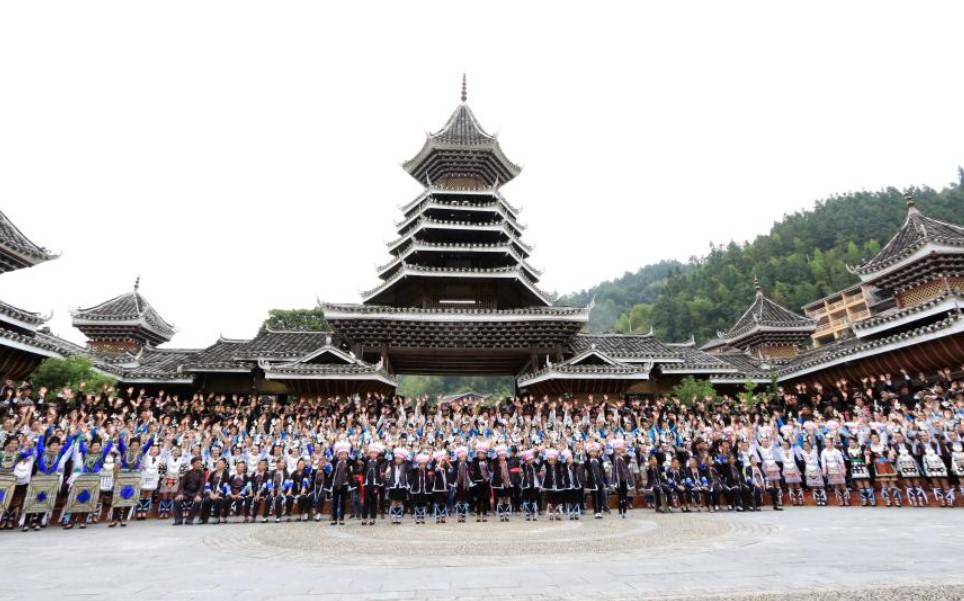
At noon, the drum ground along the Qingshui River was packed with people. Dozens of cowhide drums thundered in unison as Miao men and women in full regalia danced in circles to the rhythm. Silver ornaments chimed with every step, and embroidered skirts fluttered like butterflies—a spectacle of breathtaking grandeur. Ms. Zhang, a tourist from Hunan, held up her camera with glistening eyes: “This vitality is overwhelming. Every stitch of embroidery and every drumbeat feels alive.”
In addition to traditional activities such as courtship singing, fish catching, and bull and bird fighting, this year’s festival introduced a new “Intangible Heritage Market” and a “Digital Miao Embroidery” experience zone. Young designers integrated traditional totems into modern clothing, showcasing their creations to a global audience via livestream. An official from the Taijiang County Culture, Sports, Radio, Television, and Tourism Bureau stated that the Sisters’ Festival is not only a bond of emotion but also a living vessel for ethnic cultural heritage: “We must preserve our roots while allowing the old tree to sprout new buds.”
As twilight fell, bonfires blazed along the river. Young men and women sang flying songs to each other across the water, their voices piercing the night and echoing through the valleys for a long time. This ancient yet vibrant affection flows on, much like the Qingshui River itself—ceaseless and enduring.